Cordless grooming and cleaning devices with separate battery components

SICA ENERGY / APPLICATIONS

Lithium Batteries for Rechargeable Small Appliances

Power for everyday devices.

Discuss an OEM/ODM project

APPLICATION OVERVIEW

Start with the equipment.

Cordless cleaning devices, rechargeable fans, personal-care appliances and portable small electrical devices have different startup, running and standby loads. Define the everyday use pattern and available battery space before choosing a cell or assembly.

These examples describe the user-confirmed small-appliance scope. They are not existing SICA customer cases, certified devices or verified replacement-battery matches.

The scene above is an application concept illustration, not a customer installation or validation record.

KEY BATTERY REQUIREMENTS

Define the duty.
Then interpret the rating.

General engineering considerations below define inputs for your project. They are separate from the published specifications and do not establish SICA performance under these equipment conditions.

Startup, running and standby use
Record motor-start current, normal and high-load operation, idle demand and use duration. Include repetition and charging-during-use behaviour where applicable.
Runtime and product weight
Set the use-time objective alongside mass and ergonomics. More Ah does not establish the same runtime improvement under different loads, voltage windows and cutoff behaviour.
Battery space and assembly
Specify actual internal dimensions, cell restraint, joining and clearances. Format names alone do not establish a compatible enclosure or user-replaceable battery.
Charging interface and protection
Identify the charging source, electronics, voltage/current limits and termination. A familiar external connector does not establish compatibility with the selected cell chemistry and pack architecture.
Temperature and finished-device safety
Review repeated use, blocked airflow, charging, accessible surfaces and protection behaviour in the complete appliance. Select the evaluation and destination-market documentation requirements for the actual device.

BATTERY TYPE SELECTION

Choose the integration level.

A cell is one component of a battery system. Neither packaging format nor a family name defines the finished protection, connections, charging system or equipment qualification.

18650 and 21700 cells

These existing cylindrical formats provide initial specification references when they fit the load and available space. Protection, charger and mechanical integration remain assembly requirements.

Review the product or project scope ↗

Pouch-cell scope

A different format may be considered only when the actual cell dimensions, load and charging conditions fit. The listed large-capacity pouch cells are not general small-appliance recommendations.

Review the product or project scope ↗

Finished appliance battery

A suitable assembly must define wiring, protection, enclosure and charging for the exact appliance. The listed battery-pack configurations are not general replacements for consumer-device batteries.

Review the product or project scope ↗
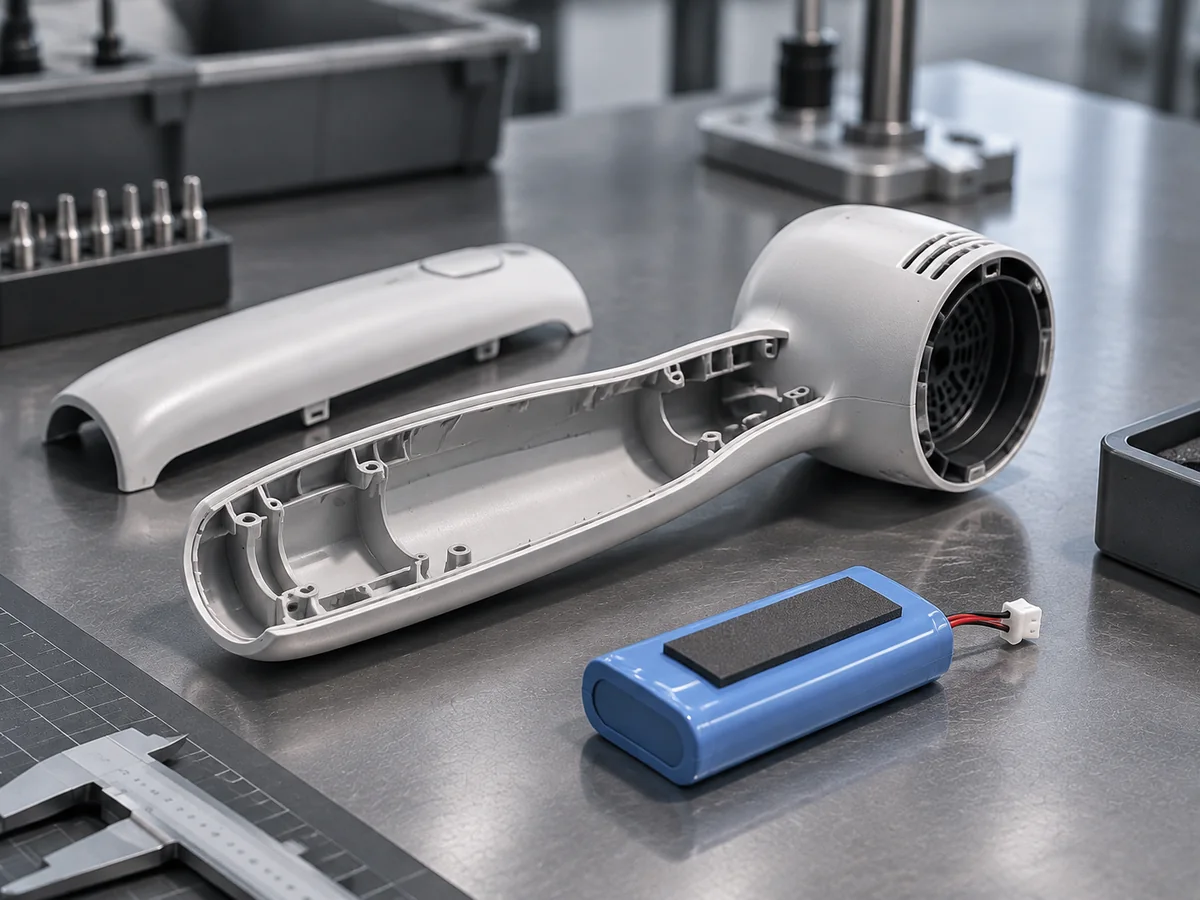
Open handheld-device housing beside a detached battery mock-up
Device integration concept; equipment fit requires review.

RELEVANT SPECIFICATION REFERENCES

Start with a compact cell reference.

Review these formats against a measured device brief. This table is not a compatibility list; larger pouch cells and the listed battery packs are intentionally outside this small-appliance shortlist.

Scroll this table horizontally on smaller screens. Keyboard users can focus the table area.

Consumer Appliances & Electronics: candidate specifications and evaluation boundaries
Product / categoryPublished specification inputsWhy review it / what to validate
INR18650-M2 ↗Cylindrical cellDiscuss this model ↗
Capacity / nominal voltage
2 Ah / 3.7 V
Continuous discharge
10 A
Maximum pulse discharge current
50 A for ≤3 seconds
Dimensions (Ø × H)
18.4 × 65.5 mm
Maximum mass
≤ 45 g

An 18650 reference for comparing space, mass and current needs in a compact assembly.

Validation focus

Check the actual motor-start and running waveform, dimensions, charging and complete device protection.

INR18650-P2 ↗Cylindrical cellDiscuss this model ↗
Capacity / nominal voltage
2 Ah / 3.7 V
Continuous discharge
30 A
Maximum pulse discharge current
80 A for ≤3 seconds
Dimensions (Ø × H)
18.4 × 65.5 mm
Maximum mass
≤ 48 g

A same-capacity comparison with M2 where the measured device duty requires a different current envelope.

Validation focus

Review temperature rise, repetitive startup, current paths and the extra mass rather than choosing by capacity alone.

INR21700-P5 ↗Cylindrical cellDiscuss this model ↗
Capacity / nominal voltage
5 Ah / 3.7 V
Continuous discharge
10C (50A)
Maximum pulse discharge current
120 A for ≤3 seconds
Additional discharge value (75°C cutoff)
70 A with a 75°C cutoff
Dimensions (Ø × H)
21.4 × 70.5 mm
Maximum mass
≤ 68 g

A 21700 reference when the enclosure and measured load justify a larger cell format.

Validation focus

Verify installation clearance, permissible load, heat paths and charger/pack integration.

INR21700-P6 ↗Cylindrical cellDiscuss this model ↗
Capacity / nominal voltage
6 Ah / 3.7 V
Continuous discharge
40 A
Maximum pulse discharge current
120 A for ≤3 seconds
Additional discharge value (75°C cutoff)
50 A with a 75°C cutoff
Dimensions (Ø × H)
21.4 × 70.5 mm
Maximum mass
≤ 72 g

A capacity/current alternative to P5 within the same listed dimensional envelope.

Validation focus

Evaluate actual operating time, startup demand, mass, charge control and device-level temperature rise.

ENGINEERING EVALUATION PROCESS

Move from a brief
to an evidence plan.

For OEM manufacturing, bring your existing specifications or drawings. For ODM development, share your operating requirements or product concept. Use the project inquiry to discuss the scope below, subject to project-specific engineering feasibility review.

  1. Describe everyday use

    Provide device type, startup/running/standby loads, use time, repetition and charging behaviour.

  2. Review the cell envelope

    Compare actual dimensions, mass, current and charging limits. A shared format does not establish a replacement battery.

  3. Check the appliance assembly

    The device designer should define protection, connections, enclosure, thermal paths and charging electronics.

  4. Evaluate the finished device

    Plan repeated use, charging, abnormal-condition and destination-market documentation review with the responsible team. Cell data alone do not establish device compliance.

  5. Discuss the purchasing brief

    Provide candidate model, quantity, market, sample evaluation needs and assembly requirements. Commercial terms and any customization are reviewed for that specific project.

RELATED TECHNOLOGY & QUALITY

Connect the choice
to the evidence.

Use the exact cell specification and assembly drawing to frame appliance evaluation. Review manufacturing scope, model-specific records and finished-device requirements separately; do not transfer a cell document to the appliance as proof of compliance.

APPLICATION FAQ

Questions before a shortlist.

Does this include common small appliances and electrical devices?

Yes. The discussion covers examples such as cordless cleaning devices, rechargeable fans, personal-care appliances and other compact rechargeable devices. Each needs its own electrical and mechanical brief.

Can a higher-capacity cell automatically extend appliance runtime?

No guaranteed runtime gain follows from Ah alone. Load profile, voltage, cutoff, usable energy, temperature and pack electronics affect the result and should be evaluated in the finished device.

Are the listed pouch cells or standard battery packs general appliance options?

No. Their capacity, size, mass, current and integration scope must fit a specific equipment requirement before any evaluation. They are not included in this compact-appliance model shortlist.

Which safety and charging information should a brand buyer provide?

Specify the charging electronics/source, protection requirements, repeated-use conditions, enclosure, target market and required device-level evidence. The cell rating or product illustration does not establish finished-device compliance.

SICA ENERGY / START A PROJECT

Start with your application requirements.

Discuss battery selection for Consumer Appliances & Electronics and the operating conditions of your equipment.

Discuss Your Application
Chat on WhatsApp