A lower peak temperature during thermal runaway can look reassuring on a comparison chart. It becomes misleading when the same aged cell begins self-heating at a lower temperature. Engineers selecting industrial battery cells need to separate the conditions that initiate a failure from the severity of the event after it starts.
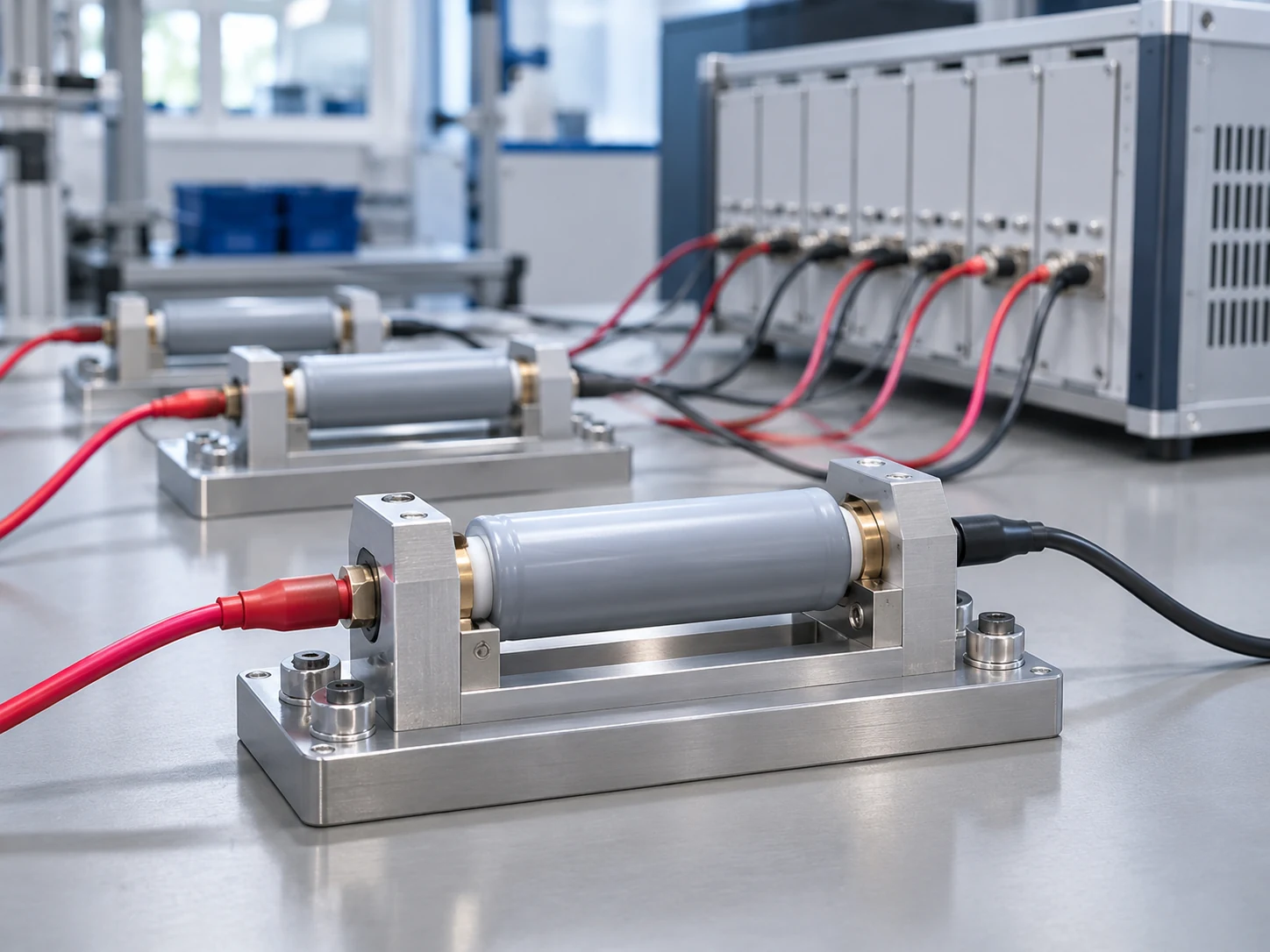
Wang Jinghao and colleagues examined this distinction in a 2025 paper on over-discharge-aged 21700 NCA cells. Their accelerating rate calorimetry results show why an undervoltage history belongs in a thermal-safety review even when capacity remains usable. The results apply to the commercial samples and protocol described in the paper. They are not measurements of SICA Energy cells, operating limits for a SICA pack, or third-party certification evidence. The supplied technical visuals accompany the explanation and do not document the original experiments or a SICA laboratory.
1. Define the Aging History and Thermal Test
What the researchers compared
The study used commercial INR21700-50E NCA cells, comparing a new reference with samples previously cycled to discharge endpoints of 2.5V, 1.0V and 0.5V. The 2.5V group represents normal cycling in that experiment. The other endpoints deliberately stress the cells beyond their normal discharge window. The preceding aging program used a common 140-cycle interval; it did not produce groups with identical remaining capacity.
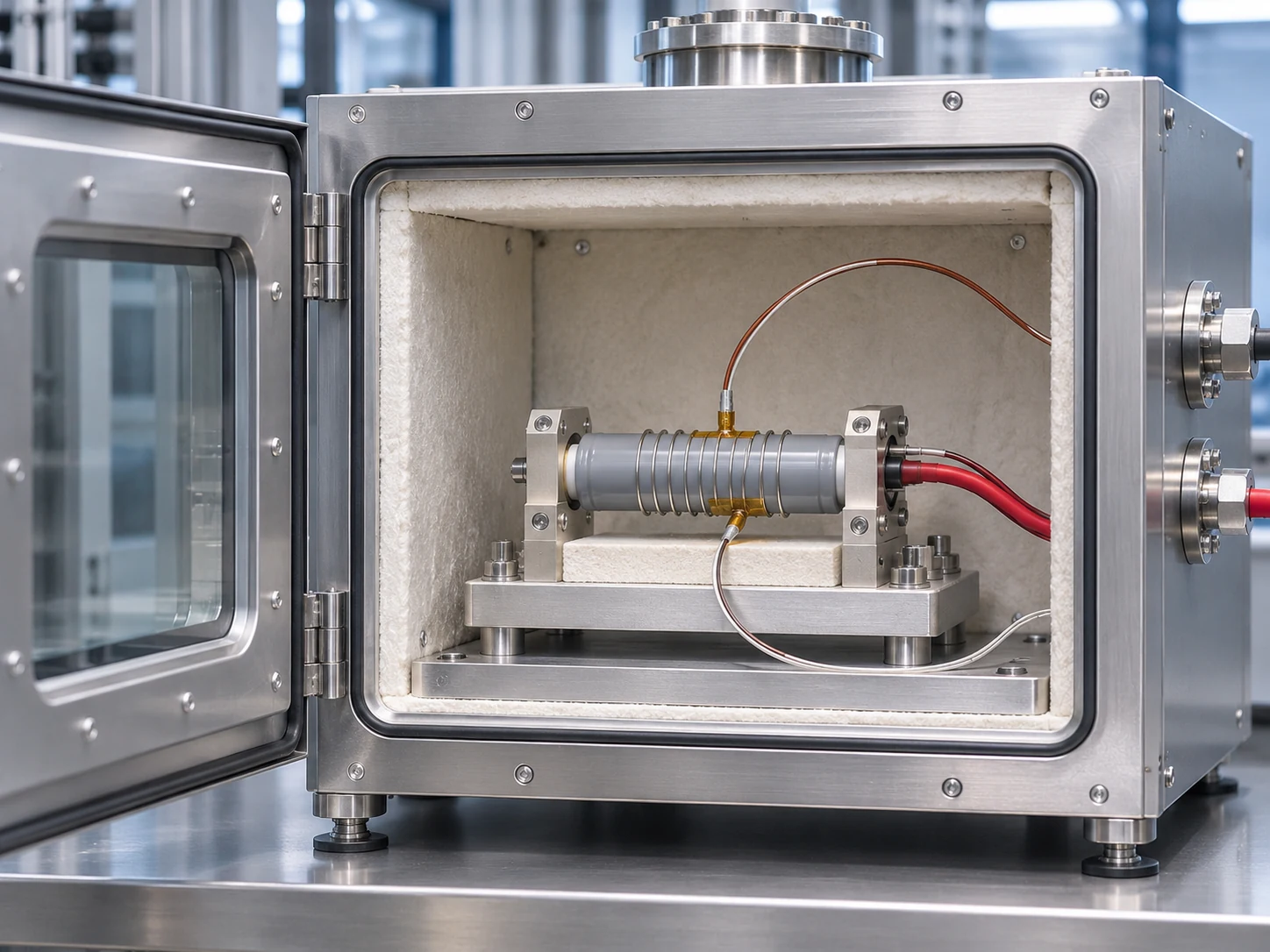
The thermal-runaway experiment used an accelerating rate calorimeter in heat-wait-search mode. Its reported starting temperature was 55°C, with 5°C heating steps and a 45-minute waiting period. A self-heating detection threshold of 0.03°C/min initiated adiabatic tracking. The paper defined thermal-runaway triggering at a temperature-rise rate of 10°C/min.
Detection thresholds shape the answer
Those definitions matter as much as the temperatures. A sensitive calorimeter can detect slow self-heating long before an externally mounted pack sensor sees a rapid rise. Comparing a self-heating threshold from one method with a runaway threshold from another can create a false impression of disagreement or precision.
The stated test termination setting was 300°C; runaway temperature overshoot produced much higher measured peaks. A setpoint is not a physical cap on an exothermic failure. These experiments belong in a suitably equipped specialist facility. Their parameters describe the research method and do not constitute a procedure for routine sample acceptance or field troubleshooting.
2. Read All the Characteristic Temperatures Together
The published table contains an important nuance
Scroll horizontally to compare all columns, if needed. →
| Literature sample history | Self-heating onset | Internal-short-circuit temperature | Runaway trigger | Peak temperature |
|---|---|---|---|---|
| New cell | 114.45°C | 123.55°C | 184.11°C | 654.69°C |
| 2.5V cycling | 108.76°C | 120.13°C | 188.22°C | 642.48°C |
| 1.0V cycling | 107.76°C | 113.39°C | 188.30°C | 619.78°C |
| 0.5V cycling | 104.68°C | 106.44°C | 185.95°C | 514.55°C |
These are the paper's Table 1 results. Self-heating onset and the temperature associated with internal short circuit declined across the listed histories. The runaway-trigger temperatures did not form a monotonically decreasing series. In particular, the aged samples' trigger values were higher than the new reference in this table.
An accurate interpretation therefore avoids saying that every thermal threshold fell with deeper over-discharge. The clearer signal is earlier self-heating and earlier internal short circuit, together with changes in reaction kinetics. The deepest-over-discharge group also triggered below the normal-cycle control, but that pairwise comparison is not a universal trend across all four rows.
Why peak temperature alone cannot rank safety
The 0.5V-aged sample reached a lower peak and lost less mass than the new reference. The authors associated this reduced event severity with consumption or loss of reactive material during aging. Yet a reduced maximum does not restore the lost thermal-stability margin. Initiation and consequence are separate design questions, and a useful safety assessment must retain both.
3. Understand the Mechanisms Without Turning Them into Guarantees
The authors connected earlier self-heating with changes in the solid-electrolyte interphase and electrode reactions after repeated over-discharge. Disruption and reformation of the protective interphase can change its stability. The paper also discusses copper dissolution and deposition as a route to separator damage and increased internal-short-circuit susceptibility.
Kinetics support a direction, not a field failure probability
The fitted self-heating activation energies were 1.25eV for the new reference, then 1.18eV, 1.13eV and 1.09eV for the 2.5V, 1.0V and 0.5V cycling groups. Within the authors' Arrhenius analysis, that declining sequence supports a lower reaction barrier following the more severe aging histories.
These fitted values are method-dependent descriptions of the selected self-heating region. They do not provide the probability that a particular pack will fail, a safe storage temperature, or a transferable BMS warning setpoint. Different material systems, construction and previous exposure can change the reaction sequence.
Keep ordinary heating and runaway evidence distinct
The companion work on discharge heat generation addresses normal discharge after aging. This paper instead uses controlled external heating to investigate a transition toward runaway. A higher discharge heat rate and earlier self-heating under abuse are related concerns, but one measurement cannot substitute for the other.
For background on capacity and discharge heating, read the over-discharge aging analysis. Treat the two articles as complementary views of related research, rather than independent confirmations of a SICA product's safety performance.
4. Translate the Findings into BMS and Pack Review Questions
Prevent the history that a final voltage reading can hide
An OEM protection review should examine individual series-group behavior, rather than relying only on total pack voltage. A weak group may reach its lower limit while the total remains apparently acceptable. Measurement accuracy, filtering, sampling timing and loaded voltage sag all influence whether the controller recognizes that condition promptly.
After discharge is interrupted, continuing consumption by monitoring electronics or connected equipment can deepen depletion during storage. A useful engineering brief therefore describes shutdown current, storage interval and restart behavior. Recovery of terminal voltage after rest does not establish that a severely depleted cell has recovered its original condition.
Review these responsibilities through BMS development: detection, warning, load isolation, fault logging and the approved response to an undervoltage event. The paper does not establish numeric thresholds or delays for that implementation. Those must come from the selected cell's documentation and the system risk assessment.
Use thermal evidence at the correct level
Cell-level calorimetry does not measure propagation through a finished module. Holder geometry, thermal contact, vent direction and nearby components influence how one failing cell affects its neighbors. Sensor placement and enclosure response also need a system-specific review.
For procurement, request a clear identification of the tested model, sample state, trigger method and report scope. A result for a fresh cell does not automatically cover a repeatedly depleted pack. Equally, a single aged-cell experiment cannot establish that a proposed enclosure prevents propagation or satisfies a market-specific approval.
5. Specify Evidence Before Selecting a 21700 Solution
Include aging path in the evaluation brief
The related master's thesis adds equal-SOH comparisons: samples reaching 80% capacity through different discharge histories still showed different thermal behavior. This reinforces a practical point: capacity retention alone is an incomplete description of condition. An agreed evaluation should record how the sample reached its state, its current capacity reference, resistance method and preparation before thermal testing.
For a sourcing project, start with the intended cylindrical-cell range and describe voltage window, duty cycle, temperature exposure and expected service life. Then use the quality page to organize model-specific documentation questions. SICA Energy's catalogue and project review remain separate from the academic NCA sample results summarized here.
Ask the engineering team to distinguish routine incoming checks from specialist destructive safety evaluation. Define who reviews an abuse event, which records support the decision and what evidence is required before returning equipment to service. These are process recommendations derived from the engineering implications; the study does not authorize a universal recharge or reuse rule.
Academic references and limits
Primary source: Wang Jinghao, Li Xichao, He Qun, Dai Zuoqiang and Zheng Lili, Analysis of Thermal Runaway Characteristics in 21700 NCA Lithium-ion Batteries after Over-discharge Cycling Aging, Journal of Qingdao University (Natural Science Edition), 2025, 38(1), 67–72, continued on p.78. DOI: 10.3969/j.issn.1006-1037.2025.01.10. The temperature comparison uses Table 1; activation energies come from the self-heating kinetics analysis.
Supplementary source: Wang Jinghao, Effects of Over-Discharge Cycling on the Electrochemical Performance and Thermal Characteristics of 21700 NCA Lithium-Ion Batteries, master's thesis, Qingdao University, 2024; English title translated for identification. Its equal-SOH discussion supplements the interpretation and should not be counted as an independent replication. Neither source establishes SICA model compliance, a complete pack safety case or compatibility with a particular application.