Choose between 6S and 12S by matching the battery's full voltage window to the aircraft's electrical architecture, then compare capacity, mass, dimensions and load requirements. SICA's eight standard configurations cover 16Ah and 22Ah LiPo or LiHV packs: 22.2V and 22.8V for 6S, and 44.4V and 45.6V for 12S. These nominal values are selection references, not charger settings or proof of aircraft compatibility. All eight list a 25C discharge rating, whose continuous-current test basis is not established in the available summary. The comparison below helps UAV manufacturers and integrators shortlist configurations for evaluation without assuming flight duration, connectors or BMS equipment.
Understand 6S and 12S Pack Architecture
Nominal Voltage and System Matching
The S designation identifies the number of series-connected cells. In the listed families, moving from 6S to 12S changes the nominal system voltage from 22.2V to 44.4V for LiPo, or from 22.8V to 45.6V for LiHV. It is a system architecture decision, not simply a choice between smaller and larger batteries.
Start with the aircraft's allowable input window and component limits. Nominal voltage is one reference point within operation; it does not establish maximum charged voltage, low-voltage behavior or permissible transients. Request the model-specific electrical limits before concluding that a pack is suitable. An existing aircraft built for one architecture should not receive another merely because a capacity or connector appears convenient.
Motor/ESC and Charger Compatibility
Check the motor and electronic speed controller documentation, power distribution, onboard converters and charging equipment as a complete system. Ask the equipment owner to identify approved voltage limits and control behavior. A motor/ESC combination intended for one voltage architecture does not become compatible with another through a battery substitution alone.
The listed pack data does not provide a complete charging procedure, charger model or connector assignment. Confirm those details for the selected configuration. LiHV is not a reason to select a higher charger setting by assumption. Charging voltage, current limits, termination and any balancing requirements need explicit agreement with the relevant model documentation.
Compare LiPo and LiHV Families
6S: 22.2V vs. 22.8V
The standard 6S LiPo options list 22.2V nominal; the 6S LiHV options list 22.8V. Both families offer 16Ah and 22Ah, but the published dimensions and masses differ. A comparison should therefore identify the exact chemistry family and capacity, not use “6S battery” as if it described one interchangeable item.

For example, the 6S 22.2V 16Ah LiPo lists a different thickness and mass from the 6S 22.8V 16Ah LiHV. Those differences matter when reviewing available space and mounting. They do not, by themselves, prove a performance advantage in a particular aircraft.
12S: 44.4V vs. 45.6V
The same distinction applies at 12S: LiPo lists 44.4V nominal and LiHV lists 45.6V. The 16Ah and 22Ah references also have different outlines and masses. Check these against the aircraft's battery bay, mechanical retention and electrical limits before moving to sample evaluation.
An Ah value describes capacity, not a complete comparison of energy across different voltages. Nominal voltage multiplied by Ah can provide a calculated nominal-energy reference, but it is not a measured usable-energy result. Usable energy in flight depends on the load, voltage limits and operating conditions. This guide makes no flight-time calculation or promise.
SICA's 16Ah and 22Ah Pack Options
Dimensions and Weight Comparison
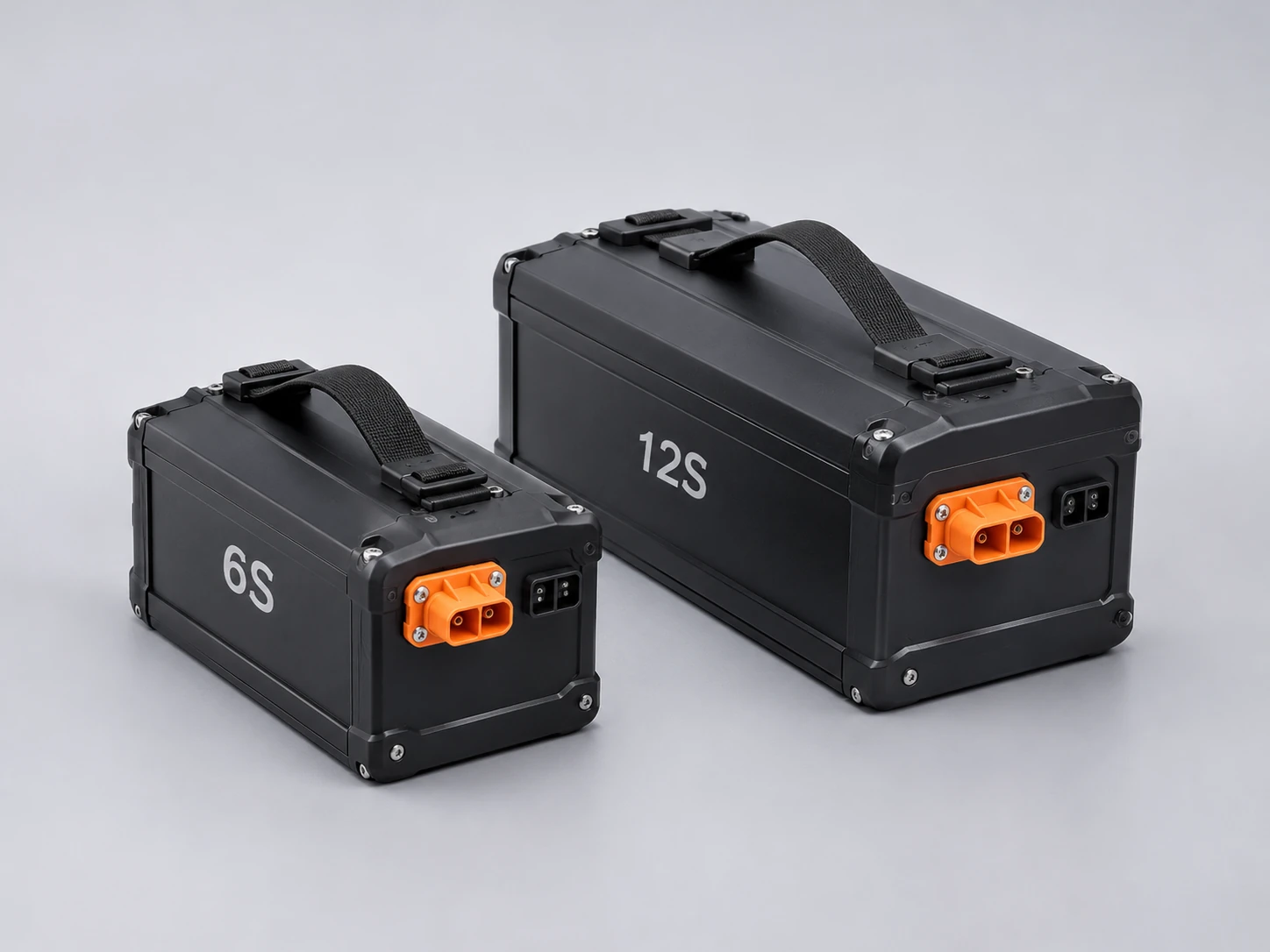
The table reproduces the eight existing standard configurations. Dimensions are thickness × width × length. Every listed mass carries a ±15g tolerance. These are product-data entries, not independent measurements from an aircraft integration test. Confirm the applicable drawing and revision before designing a close-fitting mounting system.
Scroll horizontally to compare all columns, if needed. →
| Configuration | Nominal V | Ah | T × W × L (mm) | Mass (g, ±15g) | Listed discharge |
|---|---|---|---|---|---|
| 6S 22.2V 16Ah LiPo Battery Pack | 22.2 | 16 | 71 × 75 × 180 | 2076.6 | 25C |
| 12S 44.4V 16Ah LiPo Battery Pack | 44.4 | 16 | 140 × 76 × 180 | 4153.2 | 25C |
| 6S 22.2V 22Ah LiPo Battery Pack | 22.2 | 22 | 64 × 91 × 200 | 2560 | 25C |
| 12S 44.4V 22Ah LiPo Battery Pack | 44.4 | 22 | 132 × 92 × 200 | 5120 | 25C |
| 6S 22.8V 16Ah LiHV Battery Pack | 22.8 | 16 | 61 × 75 × 180 | 1810 | 25C |
| 12S 45.6V 16Ah LiHV Battery Pack | 45.6 | 16 | 120 × 75 × 180 | 3619.8 | 25C |
| 6S 22.8V 22Ah LiHV Battery Pack | 22.8 | 22 | 61 × 91 × 200 | 2450 | 25C |
| 12S 45.6V 22Ah LiHV Battery Pack | 45.6 | 22 | 120 × 91 × 200 | 4900 | 25C |
A 16Ah and a 22Ah pack should be compared against both the required electrical duty and available installation volume. Increasing capacity changes the listed mass and dimensions. The resulting aircraft-level tradeoff includes mounting, allowable mass distribution and the mission's actual power demand; it cannot be reduced to a universal recommendation.
These standard packs are part of SICA's general battery-pack portfolio. UAV use is the context of this selection guide, rather than proof that every configuration has been qualified in every drone or that the category is limited to drones.
25C Rating: What It Does and Doesn't Establish
All eight entries list 25C as the discharge rating. The available pack summary does not establish the duration, temperature, cooling, voltage cutoff or continuous-discharge test method behind that number. It therefore should not be multiplied by capacity and presented as a verified continuous-current allowance.
Ask for the current-versus-time limits applicable to the chosen model and your operating conditions. A short startup peak, a repeated maneuver and a sustained high-load interval are different requirements. A rating without its conditions cannot resolve those differences. Nor does 25C establish connector current capability, cable sizing, BMS behavior or a complete thermal design.
Validate the UAV Integration
Connectors, Mounting and Protection
Confirm the connector type, polarity, cable length, charging/balance connection and mating part against actual documentation. Do not identify an interface from a generic product image. The current summaries do not establish that all eight packs share a connector or include the same protection arrangement.
Provide the mounting drawing and available retention space. Review whether the proposed holder, strain relief and cable route suit the selected pack. Mechanical allowances and installation requirements should come from an agreed drawing and engineering assessment, rather than a nominal outline alone. This guide does not prescribe a universal mounting pressure or clearance.

Confirm which protective functions are provided in the pack, charger or aircraft. SICA's BMS development capability is project-based; it does not imply every standard pack includes an identical BMS. Define responsibility for warning, shutdown and fault response before accepting the integration.
Load Profiles and Thermal Conditions
Collect an aircraft load trace where possible, including startup, takeoff, hover, maneuvering, payload operation and other relevant duty segments. Record ambient conditions and the cooling available at the installed location. The purpose is to define the demand to evaluate, not to infer flight duration from a brochure capacity.
Agree the sample configuration and acceptance criteria with the responsible engineering team. Cell-level figures, pack-level results and aircraft-level validation are separate evidence. SICA's in-house product quality validation can support the agreed discussion; it does not replace the aircraft manufacturer's responsibility to qualify the complete system or establish an aviation approval.
Use the UAV and drone application guide to organize integration questions. Application-oriented information is a starting point for assessment, not a list of confirmed compatible aircraft.
Select and Request a UAV Pack
Qualification Checklist
Before requesting a quotation, identify which facts are settled and which require review. This keeps a standard configuration inquiry distinct from a new engineering project and helps prevent a nominal specification from being treated as a completed qualification.
Scroll horizontally to compare all columns, if needed. →
| Review item | Buyer input | Confirmation needed |
|---|---|---|
| Electrical architecture | System voltage window and component limits | Selected pack's charge/discharge limits |
| Load demand | Continuous and peak current, duration, repetition | Model-specific permissible operating conditions |
| Installation | Drawing, mass limit, retention and cable route | Outline, tolerance and interface details |
| Charging | Charger documentation and intended procedure | Matching limits and connection arrangement |
| Evidence | Evaluation plan and target-market requirements | Applicable model records and responsibilities |
RFQ Inputs
Include the exact configuration, sample quantity, expected order quantity, destination and desired evaluation milestones. Ask for current model-specific specifications, a mechanical drawing and the relevant interface information. MOQ, availability and lead time are confirmed for the inquiry; no fixed quantities or dates are implied here.
If the standard configurations do not match the system, describe the gap before requesting changes. A custom engineering assessment can consider electrical and mechanical requirements, but a change in configuration is not automatically covered by a standard model's evidence. The manufacturing page provides the commercial entry point for that discussion.
Compare All Eight Battery Pack Configurations before selecting a reference. To Request UAV Battery Pack Quote, state the configuration and the aircraft requirements. This inquiry explicitly carries a UAV context because the buyer is following a UAV selection guide; a general pack inquiry without that context should remain unspecified. No submission is made by reading this article.