Comparing cylindrical vs pouch battery cells starts with the equipment envelope, voltage window and current over time, not a universal ranking of cell shapes. Cylindrical cells use a rigid cylindrical enclosure; pouch cells use a flexible outer package that needs a defined support and integration approach. SICA Energy manufactures cylindrical and semi-solid-state pouch cells, with model-specific capacities, voltage limits and discharge entries. The family is semi-solid-state, not all-solid-state. This guide compares the decisions an OEM team needs to make before shortlisting models. It does not present a common-method performance test, establish device compatibility or promise that one format is always safer, longer-lived or more energy-dense.
What Makes Cylindrical and Pouch Cells Different?
Form Factor and Mechanical Envelope
A cylindrical cell occupies a round cross-section. The pack layout must account for cell spacing, holders, insulation and interconnections, as well as the outline of each cell. A pouch cell has a broad, relatively flat body, but its listed thickness, width and height do not define the complete installed envelope. Tabs, support and dimensional change must be reviewed separately.

Start with the space your equipment can actually provide. Compare candidate layouts rather than treating either shape as automatically space-efficient. A rectangular device cavity is not evidence that a pouch design will fit; a cylindrical-cell holder is not a complete battery-pack structure. Mark mounting interfaces and service constraints before fixing the package.
Connections and Cell Support
The electrical connection and mechanical restraint must be evaluated together. For cylindrical cells, review terminal interfaces, joining and the chosen support arrangement. For pouches, review tab routing, joining responsibility, insulation and how loads are kept away from the tabs. Do not design either assembly around a generic product image.
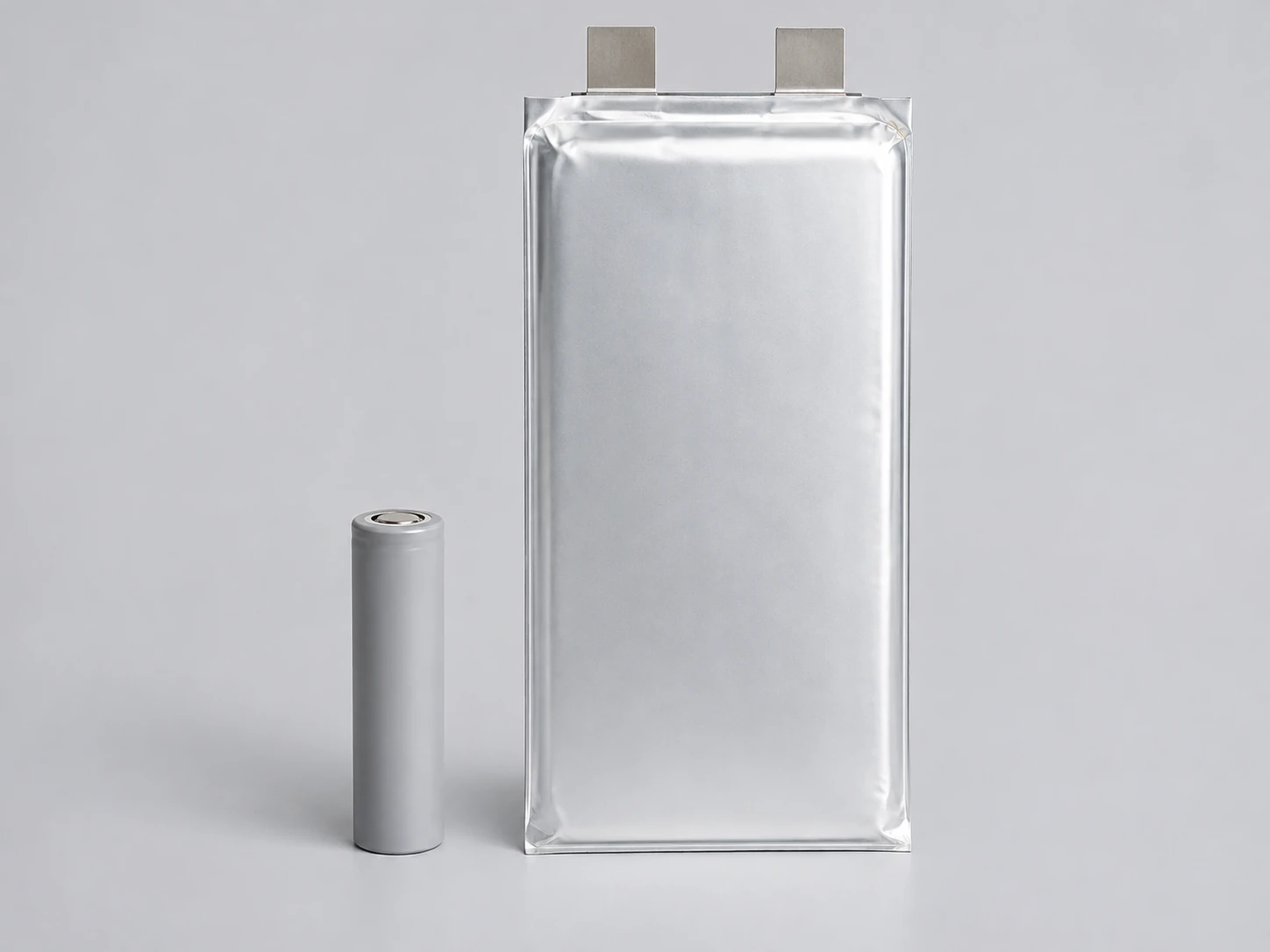
The illustrations in this article explain the formats. They do not specify welding methods, tab dimensions, compression or assembly clearances. Those decisions follow the selected model and agreed project scope. SICA's pack-engineering capability supports that discussion; it is not proof that every possible connection or mechanical arrangement is available.
Compare the Specifications That Matter
Capacity, Voltage and Continuous Discharge
Compare capacity in Ah, the voltage window and the applicable continuous-discharge entry separately. A cylindrical current stated in A and a pouch rating stated in C are not interchangeable labels. Any current calculation from C-rate and capacity still needs the source conditions and cannot establish the permissible current of a finished pack.
For example, INR21700-P5 lists 5Ah, 3.7V and 50A continuous discharge. 087187H040A lists 40Ah, a 3.46V platform and 3C continuous discharge. The available summaries do not establish aligned test conditions, so these different formats and voltage ranges cannot be presented as a controlled head-to-head test. Use the values to build an evaluation shortlist, not a power or runtime claim.
Cell-Specific Energy vs. Pack-Level Energy Density
Cell-specific energy describes energy relative to cell mass. Pack-level specific energy also depends on structure, interconnections, protection and other assembly components. A high cell-level Wh/kg value cannot simply be carried across to the completed pack. It also does not settle whether the cell meets the load or mechanical requirements.
The 087187H040A entry of 380Wh/kg is a listed cell-level value. This guide does not calculate a new Wh/kg result for the cylindrical cells or claim a common measurement method. Where the equipment has an energy-per-mass target, state whether it applies to the cells, complete battery or installed system and agree the measurement boundary.
Engineering Trade-Offs for OEM Battery Packs
Thermal Design and Duty Cycle
Describe continuous work, startup, repeated peaks and recovery intervals. The installed enclosure, ambient environment and heat paths affect the evaluation of both formats. A high current specification does not establish acceptable temperature rise in your assembly, and a listed pulse duration does not define how often that pulse can repeat.
Use the technology overview to organize the system questions. A comparison should preserve the difference between a cell rating, a sample observation and equipment-level acceptance. Changing cell shape may change the proposed heat path or arrangement; any benefit needs assessment in that design rather than an assumed thermal advantage for the entire format.
Cell Matching, Packaging and Safety Review
Identify the model, specification revision and batch controls required for the assembly. Review matching criteria with the engineering team rather than inventing a universal voltage or resistance tolerance. Layout, insulation, joining and protection should be part of the design review, alongside how the charger and equipment respond to faults.
Neither a rigid case nor a pouch package establishes safety by itself. Likewise, semi-solid-state identifies the technology family; it is not an all-solid-state claim or a substitute for model-specific validation. A cell document does not certify the finished battery or device. Agree the applicable evidence and responsibilities for the project.
SICA Cell Models to Evaluate
18650, 21700 and 32700 References
The cylindrical-cell catalogue includes eight models across three formats. P2 and M2 both list 2Ah but different continuous-current limits. P5 and P6 share a listed envelope while trading capacity against continuous current. The four 32700 models also differ; P17 uses a different nominal voltage and cutoff window.
Scroll horizontally to compare all columns, if needed. →
| Model reference | Capacity | Voltage reference | Continuous entry |
|---|---|---|---|
| INR18650-P2 | 2Ah | 3.7V nominal | 30A |
| INR21700-P5 | 5Ah | 3.7V nominal | 50A |
| INR32700-P17 | 17Ah | 3.5V nominal | 35A; 52.5A / 75°C cutoff is separate |
| 087187H040A | 40Ah | 3.46V platform | 3C; 7C / 10s pulse is separate |
These are selected specification references, not a common-test ranking or a complete catalogue table. Use each linked model page to retain the full conditions and keep maximum listed mass separate from installed pack mass.
20–50Ah Pouch References
The pouch-cell catalogue provides thirteen 20–50Ah models. The capacity range does not imply one shared voltage window, C-rate or mechanical arrangement. As examples, the 20Ah 074172H020A lists 7.8 × 74 × 172mm, while the 40Ah 087187H040A lists 10.1 × 87 × 187mm; dimensions are thickness × width × height.
Shortlist by the actual installation and load requirements. Higher capacity and higher listed specific energy answer different questions. Request an engineering review of support, interfaces and operating limits for the chosen cell, without assuming that a neighboring model has identical behavior or mounting conditions.
How to Prepare Your Cell Selection RFQ
Electrical and Mechanical Requirements
Provide the device purpose, target market, voltage window, energy or capacity target and current/time profile. Include charger information, installation envelope and mass constraints. Distinguish mandatory limits from preferences and measured loads from estimates. An early brief can identify what is known without pretending the pack design is complete.
Compare SICA Cell Models alongside the pouch range. Request OEM Cell Selection Support and state that both formats are being considered so the engineering discussion can review them against the same requirements. The inquiry category is an entry context, not an automatic selection of one format.
Samples and Qualification Documents
Specify the candidate models, sample quantity, anticipated order quantity and evaluation milestones. Ask which current specification revision and model-specific records can be reviewed. Availability, MOQ, lead time and document scope are confirmed for the actual project; this guide does not promise fixed terms or a universal qualification package.
Use Quality & Documentation to frame the evidence request. Identify who evaluates cells, designs the pack and accepts the equipment. Keeping those responsibilities explicit makes a format comparison useful to procurement without turning a short list into a compatibility guarantee.